
Tesla Powerwall 3 Installation Cost in the Bay Area
A Tesla Powerwall 3 installed in the Bay Area costs $9,000–$20,000 per unit before incentives, the published range for every home battery we install. Backup scope, wiring distance and the condition of your panel decide where you land.
Last updated: November 2026 · Sources: Tesla Powerwall 3 datasheet (North America), Tesla Energy Library: Powerwall 3 Expansion units, CPUC Net Billing Tariff, PG&E Base Services Charge, PG&E Public Safety Power Shutoffs
Often paired with: Battery storage · FranklinWH installation · Powerwall in Los Gatos · Residential solar · SGIP waitlist check · Pricing
Further reading: Powerwall 3 vs FranklinWH vs Enphase · Solar payback period under NEM 3.0 · Panel capacity for home electrification
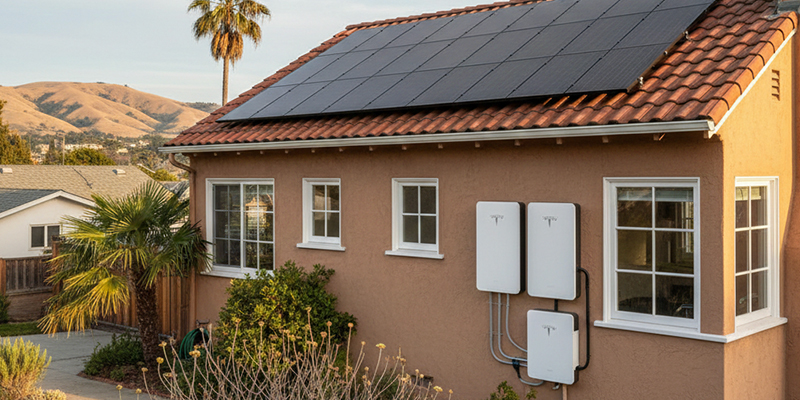
What a Powerwall 3 installation costs in the Bay Area
Every Powerwall 3 we install falls inside our published battery range of $9,000–$20,000 per unit. That figure covers the battery, the Backup Switch or Gateway, mounting, wiring, the permit set, inspection and the PG&E paperwork; it is the same number on our pricing page and the quote you receive is fixed and itemized. Tesla’s hardware price is on tesla.com, so you can see how much of the quote is the unit and how much is the electrical work.
Four things move a Bay Area quote inside that range:
- Backup scope. An essential-loads sub-panel with one Powerwall is the low end. Whole-home backup through a Backup Switch in the meter socket or a Gateway at the main panel adds hardware and a larger disconnect, and more often than not a second unit.
- Wiring distance. A battery on the garage wall next to the main panel and meter is a short run. A meter at the street, a panel at the house and a battery closet on the far side (common on hillside lots in Los Gatos, Saratoga, Orinda or Mill Valley) means conduit, sometimes a trench, and more labor.
- Panel condition. A 1960s–80s 100A service with a full busbar may need a 200A upgrade before it can take a Powerwall plus solar; that is $4,500–$14,000 on the same permit set. A SPAN smart panel is the alternative when the service itself is adequate but circuit control is the goal.
- Solar. A new array wired into the Powerwall 3’s own inverter is priced on top, at $20,000–$50,000 (about $2.50–$3.80 per watt) for the 8–13 kW most Bay Area homes need.
| Configuration | Hardware | Where it lands | Typical fit |
|---|---|---|---|
| Essential-loads backup | 1 Powerwall 3 + Gateway + backup sub-panel | Lower half of $9,000–$20,000 | Most single-family homes; refrigerator, lights, internet, furnace, pump |
| Whole-home backup, one unit | 1 Powerwall 3 + Backup Switch (meter socket) | Middle of the range | Modest homes with gas heat and no EV charging during outages |
| Whole-home backup, more storage | 1 Powerwall 3 + 1–3 Expansion units | Upper range for the first unit; Expansions priced on top at a lower per-kWh cost | Hillside homes with well pumps, multi-day PSPS, a single EV |
| Whole-home with two inverters | 2 Powerwall 3 + Gateway | Two units, each inside the range | Central AC, induction range, heat pump, two EVs; 23 kW of continuous output |
Before incentives. An Expansion unit adds 13.5 kWh of storage without a second inverter, so it costs less than a second Powerwall 3 but does not add output power. Reviewed November 2026.
Get a Fixed-Price Powerwall 3 Quote
Tesla Certified Installer, C-10 licensed, our own crew. One itemized price after a site visit, anywhere in the Bay Area.
CA Lic #1143455 · Tesla Certified Installer · Enphase · Bonded & Insured
✓ 10-year workmanship warranty · ✓ Our own licensed C-10 crew — no subcontractors · ✓ Upfront, no-pressure pricing
Get a Free Quote ☎ (650) 451-8464Powerwall 3 specs that matter for a Bay Area home
| Usable capacity | 13.5 kWh per Powerwall 3; each Powerwall 3 Expansion adds 13.5 kWh |
| Continuous power | 11.5 kW, on-grid and in backup; 185 A locked-rotor start for well pumps and AC compressors |
| Solar inverter | Built in: up to 20 kW DC of PV on 6 MPPTs, so a new array wires straight in with no separate inverter |
| Scaling | Up to 3 Expansions on the lead Powerwall 3; up to 4 Powerwall 3 units per site; 7 units maximum |
| Backup device | Backup Switch (meter socket, whole home), Gateway 3 or Backup Gateway 2 (whole home or essential loads) |
| Placement | Indoor or outdoor (NEMA 3R), floor or wall mount; garage wall and side yard are the usual Bay Area spots |
| Warranty | 10 years from Tesla, plus our 10-year workmanship warranty on the installation |
| App modes | Self-Powered, Time-Based Control, Storm Watch; configured for NEM 3.0 at commissioning |
Two of those lines explain why the Powerwall 3 is the battery we quote first in the Bay Area. The 11.5 kW output means one unit can start a well pump or an air-conditioning compressor without a second battery, and the 20 kW solar input means the array, the inverter and the storage are one permitted piece of equipment rather than three. The three app modes map directly onto PG&E’s tariff: Self-Powered holds your solar for the evening, Time-Based Control discharges into the 4–9 pm peak, and Storm Watch fills the battery from the grid when a PSPS or storm warning is issued.
Whole-home or essential-loads backup: Backup Switch, Gateway or sub-panel
The backup device is the decision that sets the price, the permit drawing and what stays on when PG&E goes dark. There are three ways to wire a Powerwall 3:
- Backup Switch, whole home. A Tesla disconnect that installs behind the utility meter in the existing meter socket, so the entire house is carried by the battery with no new panel work. It is the cleanest whole-home install when the service is 200A and PG&E approves the meter-socket device for your service type, which we confirm before quoting.
- Gateway, whole home. A Gateway 3 or Backup Gateway 2 at the main panel does the same job with a wall-mounted unit and its own breaker spaces. It is the route for services the Backup Switch does not fit, for sites with a detached meter, and for homes that add a Gateway-managed sub-panel later.
- Gateway, essential loads. The Gateway feeds a dedicated backup sub-panel that carries only the circuits you choose: refrigerator, lights, internet, furnace fan, a pump, a few outlets. Air conditioning, the range and the EV charger stay on the grid side. One Powerwall 3, the lowest price, and the right answer for most flatland homes in San Jose, Sunnyvale, Fremont or Walnut Creek.
A SPAN smart panel replaces the main panel and lets you turn individual circuits off from your phone during an outage, which makes one Powerwall behave like a larger system and can keep a 100A or 125A service from needing an upgrade. Run our free NEC load calculator if you are unsure whether your panel has room; the result tells you whether the backup load fits before anyone visits.
New solar (DC-coupled) or adding to the solar you have (AC-coupled)
New solar + Powerwall 3 is the DC-coupled case Tesla designed the product around: the panels land on the Powerwall’s six MPPT inputs, there is no string inverter on the wall, and during an outage the array keeps charging the battery at full rate. This is the configuration we quote for most new Bay Area systems, and it is the one that makes a multi-day PSPS manageable.
Existing solar + Powerwall 3 is AC-coupled: your current inverter stays, the Powerwall charges from its AC output, and the Backup Switch or Gateway islands both during an outage. Tesla allows up to 7.68 kW AC of existing solar per Powerwall inside the backup circuit, and adding an Expansion unit raises that ceiling, so a 10 kW or larger legacy array may need a second unit or an Expansion to be fully backed up. If the existing array runs on Enphase microinverters, an Enphase IQ Battery 5P is often the simpler retrofit, and we quote both so the choice is yours rather than ours.
Either way, a Powerwall 3 is also the natural time to add a Tesla Wall Connector: the charger shares the permit, the Gateway can be set to pause charging during an outage, and daytime solar then goes into the car as well as the battery.
Where a Powerwall 3 earns its keep: PSPS and outages in the Bay Area
PG&E’s Public Safety Power Shutoffs follow the high fire-threat districts, and those run through the Bay Area’s most expensive hillsides: the Oakland and Berkeley hills, Lamorinda and the Mt. Diablo foothills in the East Bay; the Santa Cruz Mountains from Los Gatos and Saratoga over to Scotts Valley and Boulder Creek; the eastern Santa Clara County hills above Milpitas and East San Jose; and the ridges of Marin and Sonoma. A June 2025 shutoff took out customers in Alameda, Contra Costa and Santa Clara counties on a forecast of 20–35 mph gusts, and fall red-flag events are longer. Equipment failures and winter storms add outages everywhere else, including flat neighborhoods that never see a PSPS notice.
The arithmetic for one Powerwall 3 is simple: 13.5 kWh covers a refrigerator, lights, internet, a furnace fan and a pump for roughly a day, and a solar array refills it each morning, so a three-day shutoff is a matter of managing air conditioning and the oven rather than a reason to book a hotel. For the Los Gatos hills, Aldercroft Heights and the Highway 17 corridor specifically, our Los Gatos solar and Powerwall page covers the neighborhood-by-neighborhood detail, the Town permit process and SVCE billing; this page stays Bay-Area-wide.
NEM 3.0, the Base Services Charge and payback
Under PG&E’s NEM 3.0 net-billing tariff, solar you export earns only about $0.05–$0.08 per kWh, while power you buy back at the 4–9 pm peak costs several times that. A Powerwall 3 holds the midday surplus and spends it in the evening, which is the entire financial case for pairing storage with solar in 2026. Since March 1, 2026 every residential PG&E bill also carries a fixed Base Services Charge of about $24.15 per month (lower for CARE and FERA customers) that no amount of solar or storage offsets, alongside lower per-kWh rates; we show it in every model rather than hiding it.
For a solar-plus-Powerwall system sized to what the household actually uses, we model a 7–12 year payback, with Tesla’s 10-year battery warranty and 25-year module warranties behind it. A Powerwall without solar is mostly an outage-protection purchase: Time-Based Control will shift some grid power off peak, but the battery cannot generate what it stores. Check your own bill in the NEM 3.0 savings calculator or the solar cost estimator, and read the NEM 3.0 + Battery Buyer’s Guide for the tariff mechanics.
Incentives for a Powerwall 3 in 2026
- SGIP — every residential battery budget is closed or waitlisted as of September 2026. Households at or below 80% of area median income, or enrolled in CARE, FERA or ESA, can join the equity waitlist; we prepare the reservation and never price the battery around it. Check your tier.
- Federal credit — the residential 30% credit ended for systems placed in service after December 31, 2025. Businesses and non-profits still have the commercial Investment Tax Credit, MACRS depreciation and direct pay.
- Property-tax exclusion — California does not reassess a home for the value an active solar system adds.
- $0-down financing — loans, plus PPA and lease options for solar-plus-storage.
- All current programs by utility and CCA are on the 2026 incentives hub.
Is Powerwall 3 the right battery?
We install three batteries and quote the one that fits, so here is the honest comparison in four sentences each.
Tesla Powerwall 3 is the default for a new solar-plus-storage system: one unit delivers 11.5 kW, the inverter is built in, and the 20 kW solar input means no separate equipment on the wall. It is the simplest permit, the cleanest wall and the fastest install of the three. Its limits are modularity (Expansions add energy but not power, and a second inverter means a second full unit) and the fact that the Tesla app is the only control surface. If you own a Tesla and want one app for car, charger and battery, it is the obvious choice.
FranklinWH aPower stores 13.6 kWh per unit with 5 kW continuous and 10 kW peak, carries a 12-year warranty, and its aGate controller is what sets it apart: it can integrate a standby generator and route loads automatically, so the generator runs only when the battery is low. It stacks past a dozen units, which suits very large all-electric homes with multiple EVs. The trade-offs are lower output per unit than the Powerwall 3 and a separate solar inverter. Pick it when a generator is part of the plan or when expansion in many steps matters more than output per box.
Enphase IQ Battery 5P is modular at 5 kWh and 3.84 kW per unit, AC-coupled, with a 15-year warranty. It is the natural retrofit for a home whose existing solar already runs Enphase microinverters, because the battery, the microinverters and the monitoring share one system and one app. Whole-home backup means stacking three or four units, which costs more wall space and more labor than one Powerwall 3. Pick it for Enphase homes or when you want to add storage in small steps.
The full head-to-head, with specs side by side, is in Powerwall 3 vs FranklinWH vs Enphase; sizing by circuit is on the battery storage page.
How a Bay Area Powerwall 3 installation runs
- Site visit and load review. We read 12 months of PG&E usage, inspect the main panel, meter and service size, walk the battery location, and run an NEC load calculation when a heat pump, EV charger or panel upgrade is on the table.
- Design and one itemized price. Backup scope (Backup Switch, Gateway or sub-panel), number of units and Expansions, DC- or AC-coupling, any panel or trenching work, all on one fixed quote.
- Permit. Plan set submitted to your city or county building department (SolarAPP+ where the jurisdiction accepts it for storage), plus the PG&E interconnection application. Typically 2–6 weeks depending on the jurisdiction.
- Installation by our own crew. 1–2 days on site for most homes: mounting, Backup Switch or Gateway, wiring, sub-panel if any, solar tie-in. A panel upgrade or a long conduit run adds a day.
- Inspection and Permission to Operate. We meet the inspector, then close out the PG&E application; PTO usually follows within a few weeks of the signed-off inspection.
- Commissioning. Tesla app under your own account, Self-Powered or Time-Based Control set for NEM 3.0, Storm Watch enabled, backup reserve chosen, and a walkthrough of what stays on when the grid drops.
Where we install Powerwall 3
From the Los Gatos office we cover the South Bay and Peninsula daily and San Francisco and the East Bay on scheduled projects: San Jose, Los Gatos, Saratoga, Campbell, Cupertino, Sunnyvale, Santa Clara, Mountain View, Palo Alto, Oakland and San Francisco, plus the Santa Cruz Mountains above Los Gatos. Check your ZIP on the service area page.
Our Guarantees
✓ Upfront, No-Surprises Pricing
The price we quote is the price for the agreed scope. If the scope or equipment changes, we agree any adjustment in writing first — never a surprise.
✓ On-Time Guarantee
We show up when we say we will, and keep you posted if anything changes.
✓ Satisfaction Guarantee
We're not finished until you're satisfied with the work.
✓ 10-Year Workmanship Warranty
Our installation labor is guaranteed for 10 years — on top of 25-year equipment warranties.
✓ Price-Match Promise: bring us a written quote from another licensed contractor and we'll beat it by at least 5%.
FAQs — Tesla Powerwall 3 installation in the Bay Area
How much does a Tesla Powerwall 3 cost installed in the Bay Area?
A Tesla Powerwall 3 installed in the Bay Area costs $9,000 to $20,000 per unit before incentives, the same published range as every home battery we install. Essential-loads backup with a short wiring run lands low; whole-home backup with a Backup Switch or Gateway, a long run between battery, panel and meter, or a panel that needs work lands high. We confirm one fixed, itemized price after a site visit, and it does not change unless the scope does.
Is the Powerwall 3 unit itself included in that price?
Yes. Our $9,000 to $20,000 per-unit range covers the battery hardware, the Backup Switch or Gateway, mounting, wiring, the permit set, inspection and the PG&E interconnection paperwork. Tesla's hardware price is on tesla.com if you want to see how the quote breaks down. Add-ons priced separately: a Powerwall 3 Expansion unit, a 200A panel upgrade at $4,500 to $14,000 when one is needed, and new solar at $20,000 to $50,000.
How many Powerwall 3 units does a Bay Area home need?
One Powerwall 3 (13.5 kWh, 11.5 kW) covers essential loads for most Bay Area homes: refrigerator, lights, internet, furnace fan, a well or booster pump and outlets through a multi-day outage when solar recharges it. Whole-home backup that includes central air conditioning, an induction range or EV charging usually calls for two units, or one Powerwall 3 plus Expansion units. Tesla allows up to four Powerwall 3 units per site and up to three Expansions on the lead unit.
Can I add a Powerwall 3 to the solar system I already have?
Yes. Powerwall 3 can be AC-coupled to an existing array, so your current panels and inverter stay in place and the battery charges from their AC output. Tesla limits AC-coupled solar in the backup circuit to 7.68 kW AC per Powerwall, and an Expansion unit raises that ceiling, so a large existing array sometimes needs a second unit or an Expansion. If your array uses Enphase microinverters, we will also price an Enphase IQ Battery 5P for comparison.
Will a Powerwall 3 keep my home running through a PG&E PSPS shutoff?
Yes, for the circuits it is sized to carry. The Backup Switch or Gateway disconnects from the grid the instant PG&E cuts power, the Powerwall picks up the house, and solar recharges it each morning, which is what makes a two- or three-day Public Safety Power Shutoff survivable in the East Bay hills or the Santa Cruz Mountains. Storm Watch charges the battery to full ahead of a forecast event. Air conditioning through a shutoff usually needs two units.
Whole-home or essential-loads backup: which should I choose?
Choose essential-loads backup if you want the lowest price and one Powerwall 3: a sub-panel carries the circuits you pick and leaves the heavy loads on the grid side. Choose whole-home backup if you need a well pump, medical equipment, a heat pump or an EV charger during an outage; a Backup Switch in the meter socket or a Gateway at the main panel carries the entire house, usually with two units. A site visit and a load calculation settle it in an hour.
Is there still a rebate or tax credit for a Powerwall 3 in California in 2026?
Mostly no. The residential 30% federal credit ended for systems placed in service after December 31, 2025, and every residential SGIP battery budget has been closed or waitlisted since September 2026. Income-qualified households (80% of area median income, or CARE, FERA or ESA enrollment) can still join the SGIP equity waitlist, which we file for you. Businesses and non-profits keep the commercial Investment Tax Credit. We never price a battery around a rebate that may not pay.
How long does a Powerwall 3 installation take, including PG&E?
One to two days on site for most homes, with a panel upgrade or a long conduit run adding a day. Before that, the city or county building permit and the PG&E interconnection application take two to six weeks depending on the jurisdiction; Permission to Operate follows the final inspection. From signed contract to a working battery, plan on four to eight weeks. We submit the permit, meet the inspector and file the PG&E paperwork ourselves.
Does a Powerwall 3 pay for itself under NEM 3.0?
Paired with a right-sized solar array, yes: we model a 7 to 12 year payback. Under NEM 3.0 exported solar earns only about $0.05 to $0.08 per kWh, so the battery's job is to hold the midday surplus and spend it during the 4 to 9 pm peak instead of exporting it. A battery alone, without solar, is mainly an outage-protection purchase; it shifts a little usage off peak but does not generate the energy it stores.
Why use a Tesla Certified Installer in the Bay Area?
Because the Powerwall 3's commissioning, Backup Switch and Gateway configuration, Expansion wiring and warranty registration all run through Tesla's installer tools, and warranty claims are far simpler when the company that installed the system is still around to file them. Pacific Edge Electric and Solar is a Tesla Certified Installer and licensed C-10 electrical contractor (CA #1143455) headquartered in Los Gatos, installing with its own crew and backing the work with a 10-year workmanship warranty.
Request Your Free Quote
Licensed, bonded & insured Bay Area electricians. Upfront pricing and same-day estimates available.
CA Lic #1143455 · Tesla Certified Installer · Enphase · Bonded & Insured
✓ 10-year workmanship warranty · ✓ Our own licensed C-10 crew — no subcontractors · ✓ Upfront, no-pressure pricing
Get a Free Quote ☎ (650) 451-8464