
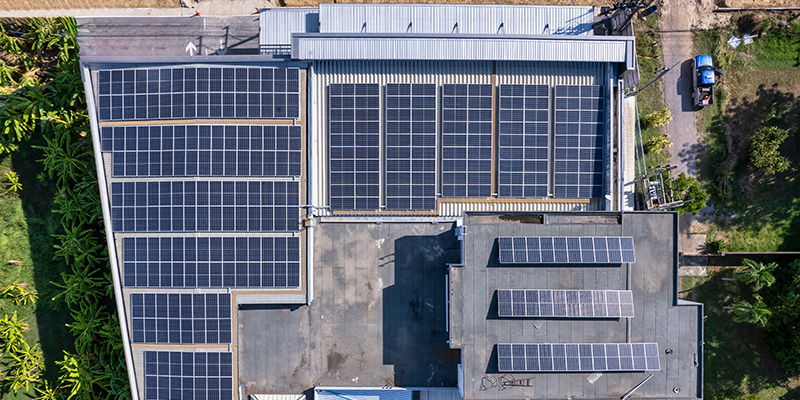
For a Bay Area business weighing solar, the headline is: commercial solar typically runs $2.00–$3.00 per watt installed, still qualifies for federal tax incentives (unlike the expired residential credit), and commonly cuts electricity costs 50–85% — with $0-down options like PPAs and leases if you'd rather not spend capital. The economics are often stronger for businesses than homeowners right now. Here's the practical breakdown.
Pacific Edge Electric and Solar is a licensed C-10 electrical contractor (CA #1143455) in Los Gatos. We design and install commercial solar and electrical across Silicon Valley — offices, light industrial, retail, and multi-tenant properties — so these are real-world figures.
What commercial solar costs
| Metric | Typical range |
|---|---|
| Installed cost | $2.00–$3.00 per watt |
| Electricity cost reduction | 50–85% |
| Upfront cost with a PPA or lease | $0 |
Per-watt cost drops with system size, so larger rooftops and carport arrays land at the low end. The exact number depends on roof type, structure, interconnection, and whether you add storage.
The incentives businesses still have (and homeowners don't)
This is the key 2026 difference: while the 30% residential solar tax credit expired after 2025, commercial and business solar still has active federal incentives — the business investment tax credit plus accelerated depreciation (MACRS), which together can offset a substantial share of project cost for a taxpaying business. That's why, right now, the payback case is frequently stronger for a business than for a homeowner. (Tax-exempt organizations have their own path via elective/direct pay — see our non-profit solar page.) Always confirm current details with your tax advisor.
Own it or go $0-down?
- Cash purchase: lowest lifetime cost and you capture the tax incentives directly — best if the business has capital and tax appetite.
- Power Purchase Agreement (PPA): a third party owns the system; you buy the power at a rate below the utility's, with no upfront cost. The developer takes the incentives.
- Solar lease: fixed monthly payment for the system, you keep the power. Predictable budgeting, no capital outlay.
Businesses that want the balance-sheet benefit and have tax appetite usually buy; those prioritizing cash flow and simplicity often go PPA or lease.
Why NEM 3.0 and storage matter for commercial too
Commercial customers face demand charges and time-of-use rates, and under NEM 3.0 exported power is worth much less than before. So the best commercial systems are designed to use the power on-site during expensive hours, often paired with battery storage to shave peak demand charges — which can be a big line item on a commercial bill. Getting that design right is where an experienced local installer earns the return.
One crew for solar and the electrical it needs
Commercial solar almost always involves electrical upgrades — service work, three-phase coordination, sometimes a switchgear or panel change. Because we're a C-10 electrical contractor, the same team handles the solar and the electrical, which avoids the scheduling gaps that stall commercial projects when trades are split. See our commercial solar services or request a commercial assessment and we'll model the options against your usage and rate schedule.
Frequently asked questions
How much does commercial solar cost in the Bay Area?
Typically $2.00–$3.00 per watt installed, with larger systems at the lower end. With a PPA or lease, the upfront cost can be $0, and systems commonly reduce electricity costs 50–85%.
Can businesses still get a solar tax credit in 2026?
Yes — unlike the expired residential credit, commercial solar still qualifies for the federal business investment tax credit and accelerated depreciation, which can offset a large share of project cost for a taxpaying business. Confirm current details with your tax advisor.
What's the difference between buying, a PPA, and a lease?
Buying gives the lowest lifetime cost and captures incentives directly. A PPA means a third party owns the system and you buy the power below utility rates with $0 down. A lease is a fixed monthly payment for the system while you keep the power. The best fit depends on your capital and tax situation.
Should a commercial system include batteries?
Often yes — batteries help shave demand charges and shift solar production into expensive time-of-use hours, which under NEM 3.0 is where much of the commercial savings now come from.
Figures are typical Bay Area planning ranges; incentive details change and vary by entity — confirm with a qualified tax professional. Written by Adam Aksoy, licensed C-10 electrical contractor (CA #1143455), Pacific Edge Electric and Solar.