
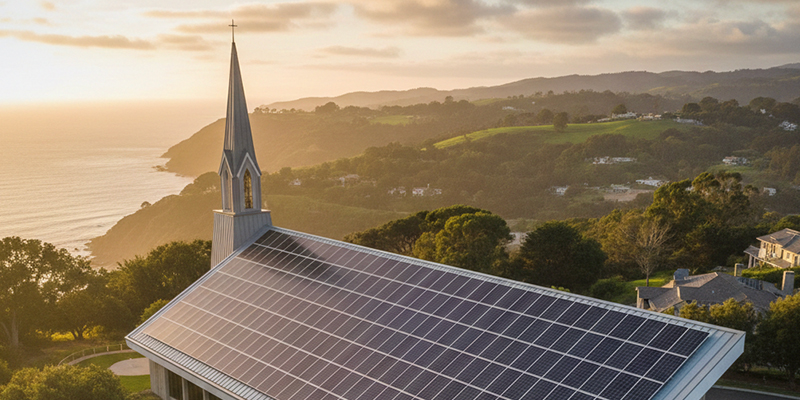
If you run a nonprofit, school, church, or community organization, here's the honest answer to the question we hear most: a nonprofit can go solar with zero money down — usually through a Power Purchase Agreement (PPA) or a solar lease, where a third party owns the system and you simply buy the power it makes at a lower rate than the utility charges. Because most nonprofits don't pay federal income tax, they can't use the solar tax credit directly, so the funding path looks different than it does for a business or a homeowner. This guide walks through the five ways California nonprofits actually pay for solar — and how to pick the right one.
Pacific Edge Electric and Solar is a licensed C-10 electrical contractor (CA #1143455) based in Los Gatos. We've wired and installed solar for homes, businesses, and community organizations across the Bay Area since 2014, so the options below come from actually doing the work — not from a brochure.
Why nonprofit solar financing is different
A for-profit business that installs solar can claim the federal Investment Tax Credit and depreciation, which together can cover a big chunk of the cost. A tax-exempt organization — a 501(c)(3), a school district, a church — has no tax bill to offset, so those incentives are worthless to it directly. For years that left nonprofits paying full sticker price while everyone else got a discount.
Two things changed the math. First, third-party ownership (PPAs and leases) lets a taxpaying partner claim the incentives and pass the savings to you as a lower power price. Second, the Inflation Reduction Act created "elective pay" (also called direct pay) — a mechanism that lets tax-exempt organizations receive the value of the federal clean-energy credit as a cash payment from the IRS, even with no tax liability. That's a genuine shift, and it's why owning the system outright is now realistic for some organizations that could never use a tax credit before.
The 5 ways California nonprofits pay for solar
| Option | Upfront cost | Who owns the system | Best for |
|---|---|---|---|
| Power Purchase Agreement (PPA) | $0 | Third-party developer | Orgs that want savings with no capital outlay |
| Solar lease | $0 | Leasing company | Orgs that want a fixed monthly payment |
| Cash purchase + elective pay | Full cost (credit refunded later) | Your organization | Orgs with reserves that want the lowest lifetime cost |
| Grants & donor / capital campaign | Varies | Your organization | Mission-aligned orgs with fundraising capacity |
| Low-interest / green loan | $0–low | Your organization | Orgs that want ownership but need to spread cost |
1. Power Purchase Agreement (PPA) — the zero-down favorite
In a PPA, a solar developer pays for, owns, and maintains the system on your roof (or carport, or ground mount). You agree to buy the electricity it produces at a set per-kWh rate that's lower than what PG&E charges, typically with a small annual escalator. No upfront cost, no maintenance headaches, and the developer — not you — captures the tax incentives. For most nonprofits without a big cash reserve, this is the path of least resistance and the one we're asked about most.
2. Solar lease — predictable monthly payment
A lease is a close cousin to a PPA. Instead of paying per kilowatt-hour, you pay a fixed monthly amount to "rent" the system, and you keep all the power it makes. Leases can be simpler to budget around because the payment doesn't move with production. The tradeoff is that in a low-sun month you still owe the same amount.
3. Cash purchase plus elective pay (direct pay)
If your organization has reserves or can run a capital campaign, buying the system outright now delivers the lowest cost over its 25+ year life — and thanks to elective pay, you can file with the IRS to receive the federal clean-energy credit as a direct cash payment even though you owe no tax. The credit is a meaningful percentage of the project cost. This route takes more paperwork and patience (you pay first, get the credit back later), so it fits organizations with the cash flow to front the project.
4. Grants, donors, and capital campaigns
Solar is an unusually easy "ask" for a mission-aligned donor: it's visible, it's measurable, and every dollar saved on the electric bill goes straight back into the mission. Foundations, environmental grants, and dedicated capital campaigns regularly fund all or part of a nonprofit's system. We've seen organizations combine a partial grant with elective pay to get to a very low net cost.
5. Low-interest and green loans
Community development financial institutions (CDFIs), credit unions, and specialty green lenders offer loans built for clean-energy projects, often with terms designed so the loan payment is at or below your current electric bill. Pair a green loan with elective pay and the credit refund can knock down the principal.
What solar actually saves a Bay Area nonprofit
The reason any of this is worth the effort: a well-designed system commonly cuts a nonprofit's electricity costs 50–85%, and under a PPA those savings start in month one with nothing out of pocket. For an organization spending $2,000–$10,000+ a month on power — a church with a big sanctuary, a school with HVAC and computer labs, a community center — that's real money redirected to programs, staff, and services, year after year.
Under California's NEM 3.0 net-billing rules, exported power is worth much less than it used to be, so the best nonprofit systems are sized to use as much energy on-site as possible, sometimes paired with battery storage to shift daytime production into evening use. Getting that sizing right is where an experienced local installer earns their keep.
How to get started
Start with your last 12 months of PG&E bills — that usage history drives everything: system size, the funding option that fits, and your projected savings. From there a good installer will model the options side by side so your board can compare a $0-down PPA against an owned system with elective pay in plain dollars.
Pacific Edge handles the full path in-house — design, permitting, our own licensed C-10 crew for the install, and interconnection with the utility — for nonprofits, schools, churches, and community organizations across the Bay Area. Learn more on our non-profit solar page, see our commercial solar services, or request a free assessment and we'll pull your options together.
Frequently asked questions
Can a nonprofit get the federal solar tax credit?
Not as a traditional tax credit, because a tax-exempt organization has no tax liability to offset. But under the Inflation Reduction Act's elective pay (direct pay) provision, a nonprofit that owns its system can receive the value of the federal clean-energy credit as a direct cash payment from the IRS. If a third party owns the system (PPA or lease), that partner claims the incentives and passes the savings to you through a lower power rate.
How can a nonprofit go solar with no money down?
The most common zero-down path is a Power Purchase Agreement (PPA) or a solar lease. A third party pays for and owns the system, and your organization simply buys the power (PPA) or pays a fixed monthly lease — both structured to cost less than your current utility bill, with no upfront capital.
Do churches and schools qualify for the same options?
Yes. Churches, private and public schools, and other tax-exempt organizations can all use PPAs, leases, grants, green loans, and — if they own the system — elective pay. Public schools and government entities have some additional financing tools available, but the core menu is the same.
What's the catch with a PPA?
The main tradeoffs are that you don't own the system (so you don't build the asset) and PPA rates usually include a small annual escalator, so the price rises modestly over time. It's still typically below the utility's rate — and PG&E's rates have historically climbed faster than most PPA escalators — but you should always compare the PPA against an owned-system scenario before signing.
This article is general information, not tax or legal advice. Confirm current federal and California incentive details with a qualified tax professional before making a decision. Written by Adam Aksoy, licensed C-10 electrical contractor (CA #1143455), Pacific Edge Electric and Solar.