
Solar Installers in Saratoga — Solar + Battery from the Company Next Door in Los Gatos
Saratoga is one town over from our office on Los Gatos Blvd. We design solar and storage around the two things that decide a Saratoga project: the trees over the roof, and whether the house sits on the flats or up in the hills where the power goes out first.
Last updated: November 2026 · Sources: City of Saratoga Building Division, SVCE service area, CPUC Net Billing Tariff, PG&E Base Services Charge
Often paired with: Solar + Powerwall (Los Gatos) · Tesla Powerwall 3 (Bay Area) · Residential solar · Saratoga electrician · Pricing
Further reading: What solar costs in the Bay Area (2026) · Solar payback period under NEM 3.0 · Powerwall 3 vs FranklinWH vs Enphase
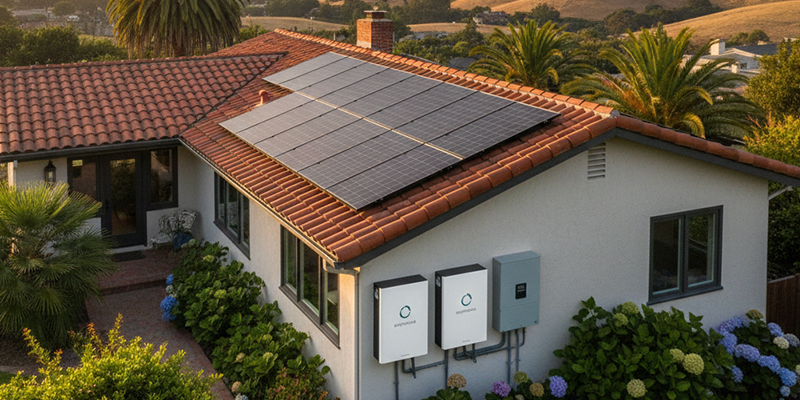
What solar costs in Saratoga
Most Saratoga houses call for 8–13 kW of solar, which prices at $20,000–$50,000 before incentives, roughly $2.50–$3.80 per watt installed. A battery adds $9,000–$20,000 per unit, and if the service needs to grow to 200A first, a panel upgrade is $4,500–$14,000. Those are the published numbers on our pricing page, and the proposal you sign is a fixed, line-by-line price.
Where a given Saratoga home lands inside those ranges comes down to roof, trees and distance. The 1960s–70s ranch homes between Saratoga Avenue and Cox Avenue, in Brookview, or around West Valley College usually have a composition roof, a garage-wall panel and a short run, so they price toward the low end. Estate lots above Pierce Road or along Big Basin Way bring clay tile, a meter at the street, a long conduit or trench run, and often a second battery, so they price toward the high end. A heavily shaded lot can go either way, which is why the shade study comes before the quote.
| Saratoga configuration | Array + storage | Price range (before incentives) | Where it fits |
|---|---|---|---|
| Solar only | 8 kW | $20,000–$30,000 | Golden Triangle, Saratoga Woods or El Quito ranch home, open composition roof |
| Solar + one battery | 10 kW + 13.5 kWh | $25,000–$38,000 + $9,000–$20,000 | Brookview, Fruitvale and Congress Springs homes; essential-loads backup and EV charging |
| Solar + two batteries | 13 kW + 27 kWh | $33,000–$50,000 + $18,000–$40,000 | Saratoga Hills, Montalvo and Pierce Road estates; whole-home PSPS backup, well pump |
Shade is the Saratoga variable
Saratoga protects its trees, and the lots show it: coast live oaks over the driveway, redwoods along the creek corridors, and street trees that have had fifty years to grow. For a solar design that is the first thing to measure, not the last. Every Saratoga site visit includes a shade analysis of each roof plane, hour by hour across the year, so the array goes on the surfaces that actually see sun and the production estimate reflects the canopy you have, not a bare-roof assumption.
Where part of the roof shades in the afternoon, we use Enphase IQ8 microinverters so each module produces independently and one shaded corner does not pull the whole string down. When the roof is simply too wooded, the honest answer may be a smaller array on the one clean plane, a ground mount on the open part of the lot, or a battery alone for outage protection. We would rather say so than oversell a roof that cannot deliver.
Batteries for the Saratoga hills
The city is split in two for outage purposes. Homes on the flats get the same grid reliability as neighboring Los Gatos and Campbell. Homes in the Saratoga hills, along Pierce Road, the Big Basin Way / Highway 9 corridor and around Montalvo sit in the City’s wildland-urban-interface area, where CAL FIRE maps parts of the city as very high fire hazard. Those are the circuits PG&E de-energizes when red-flag winds arrive: Saratoga was inside the footprint of the 2019 Public Safety Power Shutoffs, and a December 2025 fire at a PG&E substation in Saratoga blacked out roughly 21,000 South Bay customers in a morning.
For a hillside home the battery is sized around the loads that cannot stop: a well or booster pump, the refrigerator, internet, a gate opener and lighting, with the solar array recharging it each day the outage lasts. One Tesla Powerwall 3 (13.5 kWh) covers an essential-loads sub-panel; two or more with a backup gateway carry the whole house. We also install FranklinWH aPower and Enphase IQ Battery 5P when they fit better, and a SPAN smart panel when circuit-level control matters. The equipment detail, backup options and pricing are on the Tesla Powerwall 3 page and in our Los Gatos solar + Powerwall guide, and the sizing rules are on the battery storage page.
Your 2026 bill: SVCE, NEM 3.0 and the Base Services Charge
The City of Saratoga is a member of Silicon Valley Clean Energy. In practice SVCE procures the electricity for most Saratoga households and PG&E delivers it, bills it and owns the meter. Nothing about that changes who you interconnect with: the solar application and the NEM 3.0 net-billing agreement are filed with PG&E, and the export credits are applied on the SVCE generation section of the combined bill.
Two numbers then set the economics. Exported solar is credited at only about $0.05–$0.08 per kWh under NEM 3.0, and since March 1, 2026 each residential account pays a fixed Base Services Charge of about $24.15 a month that solar cannot touch, alongside lower per-kWh energy rates. The design that works in Saratoga is therefore a modest array matched to your own usage plus a battery that shifts the surplus into the 4–9 pm peak. Modeled on twelve months of your real PG&E/SVCE data, that configuration comes back in a 7–12 year payback, and the equipment carries 25-year warranties for the years after that. Try your own numbers in the NEM 3.0 savings calculator; the NEM 3.0 + Battery Buyer’s Guide explains the tariff in depth.
Get a Fixed-Price Saratoga Solar + Battery Quote
Licensed, bonded & insured Bay Area electricians. Upfront pricing and same-day estimates available.
CA Lic #1143455 · Tesla Certified Installer · Enphase · Bonded & Insured
✓ 10-year workmanship warranty · ✓ Our own licensed C-10 crew — no subcontractors · ✓ Upfront, no-pressure pricing
Get a Free Quote ☎ (650) 451-8464From site visit to Permission to Operate in Saratoga
- Site visit from Los Gatos Blvd. A fifteen-minute drive puts us at most Saratoga addresses. We pull twelve months of usage, walk every roof plane with a shade tool, open the main panel, measure the run from meter to panel to battery location, and prepare an NEC load calculation when the plan includes an EV charger, heat pump or service upgrade.
- One design, one itemized number. The array is matched to your own consumption, the battery to your evening loads and outage priorities, with trenching and panel work priced in. Heritage or hillside review flagged here if it applies.
- City of Saratoga permit. We file the plan set with the Building Division (Community Development Department) at City Hall, 13777 Fruitvale Avenue. Parcels in unincorporated county pockets go through Santa Clara County; we sort out which before filing.
- Our own crew installs. Most roofs take one to three days; tile and steep hillside pitches add a day. Long conduit or trench runs are scheduled as their own phase so the yard is disturbed once.
- Inspection and PG&E interconnection. We meet the City inspector, then file the net-billing application and follow it to Permission to Operate, generally 6–12 weeks from a signed contract.
- Commissioning. We register monitoring to your own account, set the battery for NEM 3.0 and storm-watch operation, and show you exactly which circuits stay live in a shutoff.
Saratoga neighborhoods and what we plan for
- Golden Triangle (Saratoga Ave / Saratoga-Sunnyvale Rd / Cox Ave) - 1960s ranch roofs, short runs, solar-only or one battery
- Saratoga Woods & El Quito - single-story homes near Prospect High and El Quito Park, EV charging added to solar
- Brookview - 1960s–70s tracts, mature street trees, microinverters and shade studies
- Fruitvale & West Valley College area - larger lots, 100A–125A panels to check, panel upgrades paired with solar
- Congress Springs - southwest corner near the creek, tree cover, one-battery essential-loads backup
- Saratoga Village & Saratoga Avenue - older homes, heritage designation check, rear-plane arrays
- Saratoga Hills, Pierce Road & Montalvo - tile roofs, estate lots, street-side meters, multi-battery whole-home backup
- Big Basin Way / Highway 9 corridor - wildland-urban interface, PSPS-first design, well pumps and gates on backup
Equipment we install in Saratoga
- Panels: Tier-1 monocrystalline modules, 25-year product and performance coverage
- Inverters: Enphase IQ8 microinverters for shaded and multi-plane roofs, or the Powerwall 3’s integrated inverter on open roofs
- Batteries: Tesla Powerwall 3 at 13.5 kWh, plus FranklinWH aPower and the Enphase IQ Battery 5P
- Smart panels: SPAN for per-circuit backup control and load management on smaller services
- EV charging: Tesla Wall Connector or a universal Level 2 unit on a permitted 60A circuit, $2,200–$3,100 at 10–100 ft (charger not included)
We hold Tesla, Enphase, SPAN and FranklinWH installer certifications, so a warranty claim is a call to us rather than a manufacturer queue. See products & equipment.
Incentives still available in Saratoga (2026)
- Property-tax exclusion — a solar system does not raise your assessed value in California
- Financing — $0-down loans, PPAs and leases
- SGIP — the residential battery budgets have been closed or waitlisted since September 2026; income-qualified households may still join the equity waitlist — see if you qualify
- Commercial owners — the federal Investment Tax Credit, MACRS depreciation and direct pay for tax-exempt organizations still apply
- Gone: the 30% residential federal credit, for any system placed in service after 2025. SVCE has no battery rebate of its own.
Our Guarantees
✓ Upfront, No-Surprises Pricing
The price we quote is the price for the agreed scope. If the scope or equipment changes, we agree any adjustment in writing first — never a surprise.
✓ On-Time Guarantee
We show up when we say we will, and keep you posted if anything changes.
✓ Satisfaction Guarantee
We're not finished until you're satisfied with the work.
✓ 10-Year Workmanship Warranty
Our installation labor is guaranteed for 10 years — on top of 25-year equipment warranties.
✓ Price-Match Promise: bring us a written quote from another licensed contractor and we'll beat it by at least 5%.
FAQs — Solar and Batteries in Saratoga
How much does solar cost in Saratoga in 2026?
Plan on $20,000 to $50,000 before incentives, which is about $2.50 to $3.80 per watt for the 8 to 13 kW arrays Saratoga homes usually need. A battery is another $9,000 to $20,000 installed. A single-story ranch in the Golden Triangle or Brookview with an open composition roof lands near the bottom; a tile-roof estate off Pierce Road with the meter at the gate lands near the top. Our quotes are fixed and itemized.
Do I need a battery with solar in Saratoga?
Not strictly, but most Saratoga owners end up wanting one for two reasons. Under NEM 3.0 the grid pays only about $0.05 to $0.08 per kWh for exports, so storing afternoon production for the 4 to 9 pm peak is what protects the savings. And above the flats, in the hills along Highway 9 and Pierce Road, a battery is what keeps the well pump, refrigerator and internet running through a Public Safety Power Shutoff.
Is my Saratoga electricity from PG&E or Silicon Valley Clean Energy?
Both, on one bill. The City of Saratoga is a member community of Silicon Valley Clean Energy, which buys the generation for most households, while PG&E owns the wires, meters the house and delivers the power. Your solar interconnection and NEM 3.0 net-billing agreement are filed with PG&E, and the export credits appear on the SVCE generation portion of the statement. We explain the split before you commit to a design.
How does NEM 3.0 change the way a Saratoga system is sized?
It rewards self-consumption and penalizes overbuilding. Because exported energy is credited at roughly $0.05 to $0.08 per kWh, a large array that pushes power onto the grid at midday earns little. We size the solar to your own annual use, add a battery that carries evening loads, and model the result against twelve months of real PG&E and SVCE data. Done that way, Saratoga projects pencil out at a 7 to 12 year payback.
Can solar wipe out the PG&E Base Services Charge?
No. Since March 1, 2026 every residential PG&E account pays a fixed Base Services Charge of about $24.15 a month (reduced for CARE and FERA customers), and no amount of solar or battery output offsets it. The per-kWh energy rates fell at the same time. Your savings come from the kilowatt-hours you no longer buy during peak hours, which is why we design for self-consumption rather than exports.
Who files the City of Saratoga permit and the PG&E paperwork?
We do, start to finish. The plan set goes to the City of Saratoga Community Development Department, Building Division at City Hall, 13777 Fruitvale Avenue, where the Permit Center is open weekday mornings and afternoons. We meet the City inspector, then submit the PG&E net-billing interconnection application and carry it through to Permission to Operate. Hillside parcels that fall in unincorporated Santa Clara County are permitted through the County instead, and we confirm which applies before quoting.
My lot is full of oaks and redwoods. Is solar even worth it?
Often yes, but only after a real shade study. Saratoga's mature canopy is the biggest design variable we see here, so the site visit includes a shade analysis of every roof plane across the year. When one section shades at 3 pm, Enphase microinverters keep the rest producing at full output. If the usable roof is simply too small, we will tell you and may suggest a ground mount on the open part of the lot instead.
Does solar work on a tile roof on a Saratoga hillside?
Yes. Clay and concrete tile get tile-hook or tile-replacement flashings so the roof stays watertight, and the steeper hillside pitches add staging time rather than risk. The bigger hillside question is distance: a meter at the driveway gate and a main panel at the house can mean a long conduit or trench run, and the battery location is chosen with that in mind. We price those runs in the quote, not after.
Is the 30% federal solar tax credit still available in Saratoga?
Not for homeowner-owned systems placed in service after December 31, 2025. What a Saratoga resident can still use is the California property-tax exclusion for solar, $0-down loans and PPA options, and, for businesses and non-profits, the commercial Investment Tax Credit. SGIP residential battery budgets have been closed or waitlisted since September 2026. Confirm your own situation with a tax advisor.
Does a Saratoga Village or heritage home need extra approval for solar?
Sometimes. The City of Saratoga requires a written permit before exterior alterations to a designated heritage resource, with the Heritage Preservation Commission advising on the application, and homes on a designated heritage lane get a similar look. For a Village-area or older Saratoga Avenue property we check the designation first, then design the array on rear or secondary roof planes so the review goes smoothly. Most Saratoga homes are not designated and need only the building permit.
Request Your Free Quote
Licensed, bonded & insured Bay Area electricians. Upfront pricing and same-day estimates available.
CA Lic #1143455 · Tesla Certified Installer · Enphase · Bonded & Insured
✓ 10-year workmanship warranty · ✓ Our own licensed C-10 crew — no subcontractors · ✓ Upfront, no-pressure pricing
Get a Free Quote ☎ (650) 451-8464